
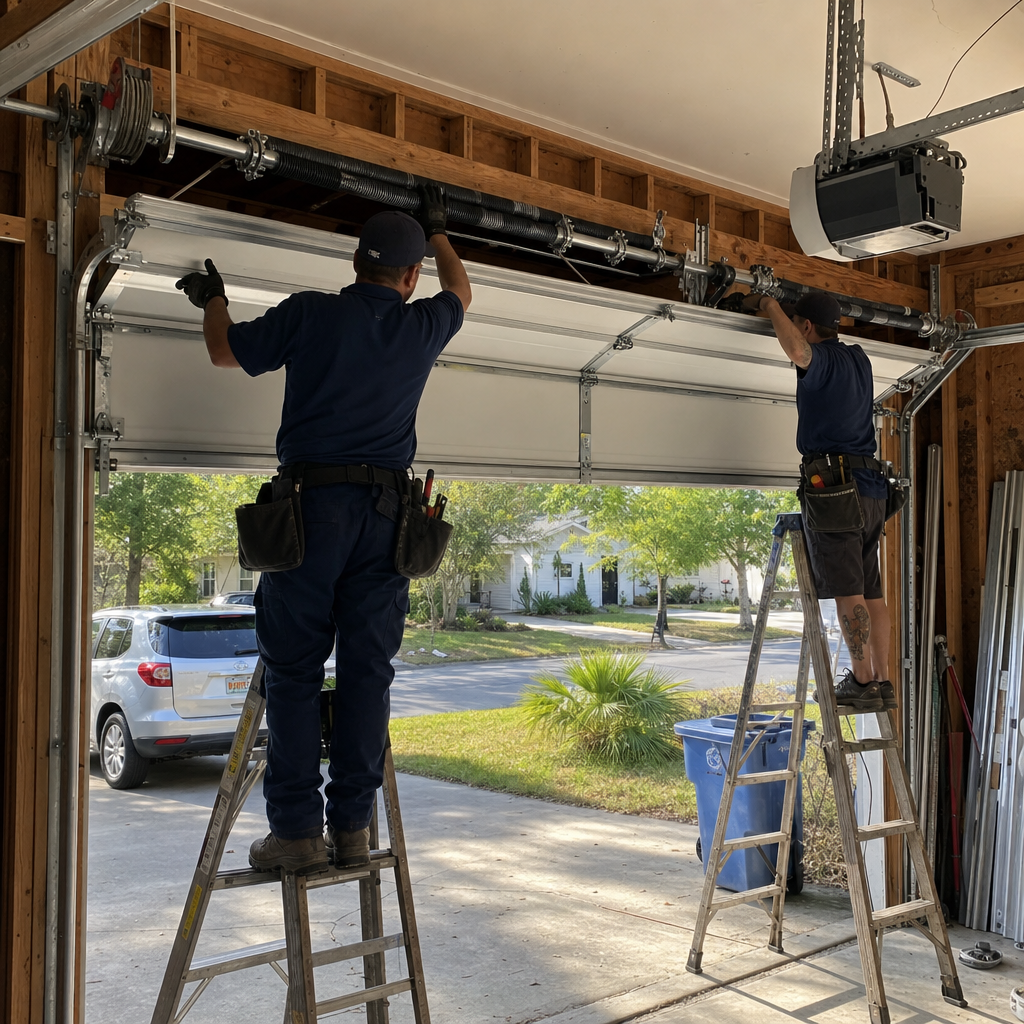
Amarr Weather Seal Replacement: The Florida Owner’s Guide
Amarr weather seal replacement in Florida typically runs $150-$600 installed, depending on door width and whether the retainer track also needs work. We stock Amarr-compatible seals for the common 9-foot and 16-foot residential widths on every truck, and most replacements are finished in under an hour. If you’re seeing daylight under the door or finding water after a Florida downpour, the seal has likely hardened past the point of doing its job.
Homeowners usually notice the failure during our summer storms, when water sheets across the garage floor, or when the electric bill climbs because conditioned air is leaking out the bottom of the door. The rubber or vinyl seal on an Amarr door sits in an aluminum retainer at the bottom of the lowest panel. After three to five years in Florida’s UV and humidity, that material cracks, compresses, or separates from its mounting. We see this exact pattern in communities from Jupiter to Fort Lauderdale, especially on doors facing west with no afternoon shade.
Which Amarr Models This Applies To
Amarr has produced weather seals across at least four distinct retainer profiles, and matching the wrong one leaves a gap or causes the door to bind. The most common residential series we encounter in Florida are the Stratford, Lincoln, and Oak Summit lines, each using a slightly different bottom seal geometry. Stratford and Lincoln doors from the 2000s through mid-2010s typically use a T-end bulb seal in a single-channel retainer. The Oak Summit and more recent Hillcrest designs often shift to a bead-end or P-bulb profile that seats differently.
To identify your seal without guessing, look for the Amarr sticker on the interior side of the top panel, which lists the model series and sometimes the manufacture quarter. If that sticker is gone, measure the retainer channel width at the bottom of the door: 1/4-inch, 5/16-inch, and 3/8-inch are the three standards, and each takes a different seal foot. We carry OEM-grade Amarr-compatible seals and a quality aftermarket equivalent made from EPDM rubber rated for Florida UV exposure. The aftermarket option costs less and outlasts the original vinyl in our climate, which is why we keep both on the truck and explain the difference before quoting.
Signs Your Amarr Weather Seal Replacement Is Failing
- Water intrusion after rain. Florida’s sheet-flow rainfall overwhelms a cracked or flattened seal fast. If you see a consistent wet line across the garage floor directly under the door, the seal has lost contact with the concrete. The cause is usually compression set, where the bulb no longer springs back after years of parking on it.
- Visible daylight under the closed door. Stand inside your garage on a bright day and look at the bottom gap. Any light showing through means air, moisture, and insects have a clear path. On Amarr doors, this often starts at the corners where the seal meets the bottom of the track, then spreads toward the center.
- Increased garage humidity or musty odor. A failed seal lets Florida’s ambient humidity colonize the garage, which damages stored items and can corrode tools or door hardware. We see this in coastal Florida homes where the salt air accelerates the problem once the seal barrier is gone.
- The seal is visibly cracked, torn, or pulling from the retainer. UV degradation turns the rubber brittle and causes surface checking, those small cracks that grow into splits. On vinyl seals common to older Amarr installations, the material can actually shrink lengthwise, exposing inches of bare retainer at either end.
- Pest activity near the door threshold. Ants, palmetto bugs, and the occasional snake use the gap at a failed seal as a highway. If you’re treating the garage for insects and they keep returning, the seal is likely the entry point they’ve mapped.
Replacement Cost & What’s Included
Amarr weather seal replacement falls under our general garage door repair pricing at $150-$600, with most single-car and standard two-car doors landing in the $180-$280 range. The variables are straightforward: door width, retainer condition, and whether we need to adjust the door’s closing limit so the new seal seats properly without overcompressing.
Our price includes removal of the old seal, inspection of the aluminum retainer for bends or corrosion, installation of the new seal cut to exact length, and a closing-force test to confirm the opener does not strain against the fresh material. Every seal replacement is covered by our 90-Day Done Right Promise, stated in writing before we leave. We do not add trip charges or surprise fees after the work is done. The price we quote on the phone is the price on the invoice.
DIY or Call Us?
Replacing a weather seal is among the safer garage door tasks a homeowner can attempt, and we will not pretend otherwise. The risks are minimal: the seal slides into a retainer, there is no spring tension involved, and no electrical work. Where DIY goes wrong is in the measurement and the material. A seal ordered online that does not match the retainer profile will not seat, and the cheap PVC blends sold at big-box stores harden within a year in Florida sun.
If you want to check your seal yourself, pull a short section from one end of the retainer and photograph the cross-section. Bring that photo and your door width when you call. We will tell you whether it matches what we stock. If the retainer itself is bent or the screws are stripped out, that is where the job turns, and where our truck inventory saves a second trip. Do it right the first time. The second trip costs everybody. Call (844) 871-6326 and we will confirm the part before we roll.
FAQs
Three to five years is typical for original vinyl seals in full Florida sun, while quality EPDM rubber replacements often reach seven to ten years. West-facing doors with no overhang degrade fastest. Call (844) 871-6326 for a free inspection if you are unsure of your seal’s age.
No. Once the material has cracked, compressed, or shrunk, there is no adhesive or patch that restores the continuous seal the door needs. Replacement is the only fix that lasts. We carry both OEM-style and upgraded EPDM seals on every truck, so the job is finished in one visit.
Most Amarr weather seal replacements take 30 to 60 minutes from truck arrival to cleanup. We also inspect the retainer, bottom brackets, and closing force while the door is open, so you are not calling us back for a related issue in three months.
Yes. We carry seals compatible with Amarr’s T-end, bead-end, and P-bulb retainer profiles in the two most common residential widths, plus the tools to cut and seat them precisely. If your door is an unusual size or an older Amarr commercial model, we will source the correct seal and return, but that is rare. Most Florida homes we serve are completed without a second trip.
Written by Dale Hutchins, Owner, Mainspring Garage Door Co. of Florida at Mainspring Garage Door Co. of Florida, serving Florida and nearby areas.